

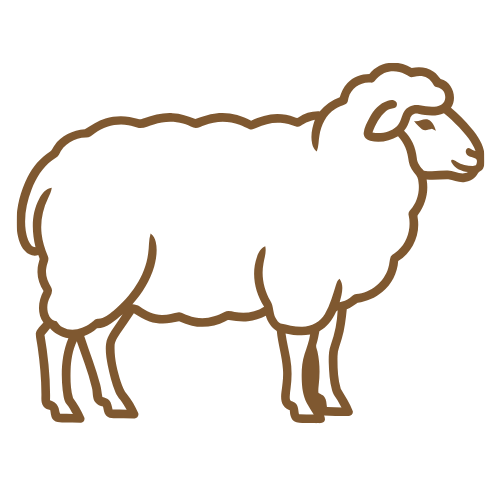
Originating from a cross between the Dorset Horn and the Blackhead Persian, Dorper sheep thrive in various climatic conditions, making them a popular choice among farmers. The breed is characterized by its muscular build, short wool, and hardiness. The White Dorper, a variant of the Dorper, features a white coat and is equally valued for its meat production. Both breeds are recognized for their efficient growth rates, good fertility, and ability to graze on sparse vegetation, contributing to sustainable farming practices.
These traits are vital when making the right selection, having been carefully cultivated within the breed for more than sixty years. It is our duty to preserve them so that future generations continue to benefit, rather than risk losing or neglecting these essential qualities in the breeding process.

Dorpers are renowned for producing lean, tender meat with excellent carcass yield.
They have strong reproductive performance, often lambing three times in two years.

Lambs gain weight quickly, making them efficient for commercial meat production.

Developed for arid regions, Dorpers thrive in diverse climates and farming conditions.

Their short coat requires minimal shearing, reducing labor and upkeep.

Ewes are known for good milk production and nurturing instincts.
Early Dorper sheep were white with black patches across their bodies, but by 1957 breeders began focusing on achieving a more even color distribution, leading to the uniform appearance seen today. The breed’s popularity grew steadily, with membership peaking at 910 breeders in 1984/85.
Dorper numbers expanded dramatically, rising from 2.6 million in 1963/64 to 6.6 million by 1990, and are currently estimated at over 5 million in South Africa. The first National Dorper Show was held in Hopetown in 1955, and it has since developed into one of the largest small stock exhibitions worldwide. Between 1988 and 1998, more than 1,000 animals competed annually for top honors. Regional and club shows continue to be held across the country, while since 2002, South Africa has hosted the prestigious World Championship Dorper Show every second year.
At Grootfontein, the main research center for the Karoo, officials set out to evaluate cross‑breeding strategies by testing purebred British mutton rams on indigenous fat‑tail breeds. Their aim was to introduce British traits without losing local hardiness, and later to use half‑cross Dorset Horn × Persian rams to upgrade the indigenous stock. This phase began in 1941 after purebred British breeds proved costly and less viable. The ultimate goal was to establish an improved South African mutton breed, with Dorset × Persian crosses showing promise for ewes lambing in autumn or conceiving in late spring.